
Understanding the 12 Meridians in Traditional Chinese Medicine

If you’ve ever wondered why an acupuncturist might place a needle in your hand when your head hurts—or choose a point near your ankle when your concern is somewhere else entirely—the answer may have something to do with meridians.
Meridians are one of the foundational concepts of Traditional Chinese Medicine (TCM). They provide a framework practitioners use to understand relationships between different areas and functions of the body and to select acupuncture points as part of an individualized treatment.
There are 12 primary meridians, and each follows its own pathway through the body. Let’s take a closer look at what that means.
First, What Exactly Is a Meridian?
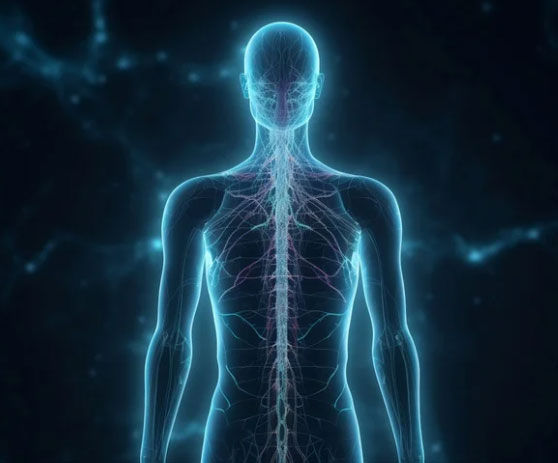
Traditional Chinese Medicine describes the body as an interconnected system rather than a collection of completely separate parts. Within this system, qi (pronounced “chee”) is understood to move through pathways called meridians.
Qi is commonly translated as “energy,” but the traditional concept is more complex than that simple definition suggests.
You can picture the meridians as a map that practitioners have used for centuries to understand connections throughout the body. Along these pathways are acupuncture points—specific locations that may be selected during a treatment based on your symptoms and overall TCM pattern.
Meridians are a concept from Traditional Chinese Medicine and shouldn't be confused with anatomical structures such as nerves, arteries, or veins.
Why Are There 12 Main Meridians?
Traditional Chinese Medicine recognizes 12 primary meridians. Each is named for an organ, but this can be a little confusing at first.
When an acupuncturist talks about the “Liver,” “Heart,” or “Kidney,” for example, they may be referring to a much broader TCM system rather than only the physical organ itself.
Each of the 12 meridians is also categorized as either yin or yang and connected with one of the Five Elements used in Chinese medicine: Wood, Fire, Earth, Metal, and Water.
The Five Element relationships are:
Wood: Liver and Gallbladder
Fire: Heart, Small Intestine, Pericardium, and Triple Warmer
Earth: Spleen and Stomach
Metal: Lung and Large Intestine
Water: Kidney and Bladder
These groupings are another part of the framework practitioners use when looking for patterns and relationships within the body.
Meet the 12 Meridians
Lung
The Lung meridian travels from the chest down the inner portion of the arm toward the thumb.
Within TCM, the Lung system is associated with breathing and the movement of qi. Traditional theory also connects it with the skin and the body's protective functions, as well as certain emotional patterns.
Element: Metal
Large Intestine
Beginning at the hand, the Large Intestine meridian travels upward along the arm and continues toward the face.
It is paired with the Lung meridian. In Chinese medicine, this system is traditionally associated with elimination and letting go of what the body no longer needs.
Element: Metal
Stomach
The Stomach meridian has a long pathway, beginning around the face and continuing down the front of the body and legs.
Its traditional functions center largely around receiving and processing nourishment. Because TCM views digestion as important to the body's ability to create and maintain energy, the Stomach system can be considered in relation to concerns that extend beyond the stomach itself.
Element: Earth
Spleen
The Spleen meridian begins near the foot and travels upward along the inner leg toward the abdomen and chest.
In TCM, the Spleen is closely connected with digestion and the body's ability to use nourishment effectively. Its traditional functions also relate to energy and maintaining strength and support within the body.
Element: Earth
Heart
The Heart meridian begins in the chest and follows the inner arm toward the little finger.
Chinese medicine gives the Heart a particularly important role. Beyond its connection with circulation, the Heart system is traditionally associated with sleep, emotional well-being, mental activity, and what TCM sometimes describes as the *Shen*, or spirit.
Element: Fire
Small Intestine
The Small Intestine meridian starts at the little finger and travels upward along the arm toward the shoulder and face.
Traditional Chinese Medicine associates this system with sorting and separating—determining what the body can use and what it should release.
Element: Fire
Kidney
The Kidney meridian begins on the bottom of the foot and continues upward along the inner leg and torso.
The TCM concept of the Kidney is considerably broader than the anatomical kidneys. It is traditionally connected with foundational vitality and with processes such as growth, development, reproduction, and aging.
Element: Water
Bladder
The Bladder meridian follows one of the longest routes of the 12 primary meridians. It begins near the eye, travels over the head and down the back, and continues along the legs toward the feet.
Many commonly used acupuncture points are found along this pathway, particularly on the back. Within TCM, the Bladder system is paired with the Kidney system and has traditional associations with fluid metabolism and elimination.
Element: Water
Liver
Beginning at the foot, the Liver meridian travels along the inner leg and into the torso.
One of the Liver's central roles in Chinese medicine is supporting the smooth movement of qi. Traditional theory also associates this system with tendons, menstrual health, and emotional patterns, particularly those connected with stress and frustration.
Element: Wood
Gallbladder
The Gallbladder meridian follows the sides of the body, beginning near the eye and moving around the head before continuing down the torso and outer leg.
It works as a pair with the Liver system. Within TCM theory, the Gallbladder is traditionally associated with the smooth functioning and movement of qi and is also connected with decisiveness and flexibility.
Element: Wood
Pericardium
The Pericardium meridian travels from the chest along the inner arm toward the middle finger.
Anatomically, the pericardium is the membrane surrounding the heart. Within Chinese medicine, however, the Pericardium has its own meridian and is closely related to the Heart system, with traditional associations involving circulation and emotional well-being.
Element: Fire
Triple Warmer
The Triple Warmer may be the least familiar of the 12 because there isn't a Western anatomical organ called the “triple warmer.”
Also known as the San Jiao or Triple Burner, it represents a functional concept within Traditional Chinese Medicine. Rather than describing one physical structure, it relates to communication and coordination between different regions of the body and the movement of qi and fluids.
Element: Fire
So, How Does Your Acupuncturist Use This Information?
You don't need to memorize the meridians to benefit from acupuncture. Your practitioner uses this framework as one piece of a much larger picture.
Before and during treatment, an acupuncturist may ask about much more than the symptom that brought you through the door. They may want to know about your sleep, digestion, energy, stress, appetite, menstrual cycle, temperature changes, headaches, pain, or other patterns you've noticed.
Those details help build a picture of what's happening from a Traditional Chinese Medicine perspective.
Based on that information, your acupuncturist selects points that fit your individual pattern. Some may be close to the area bothering you, while others can be surprisingly far away.
That's one reason two people seeking acupuncture for the same concern won't necessarily receive the same treatment.
It’s All About Connections
The idea of interconnectedness is one of the themes that runs throughout Traditional Chinese Medicine.
Instead of looking only at *where* you're experiencing a symptom, a practitioner may also consider what else is happening throughout your body and how those pieces fit together.
The meridian system is one of the tools used to make those connections.
It also helps explain why acupuncture treatments can look quite different from person to person. Your treatment is based on your individual symptoms, health history, and patterns rather than a standard set of points used for everyone.
Curious About Acupuncture?
At Latitude Acupuncture & Wellness in South Burlington, Vermont, acupuncture care is personalized to you. We take the time to learn what's bringing you in, talk through your health history and concerns, and create a treatment plan based on your individual needs.
Latitude founder Lindsay M. Kintop, L.Ac., Dipl. OM, RN, BSN is both a Licensed Acupuncturist and Registered Nurse, bringing experience in Eastern and Western approaches to health and wellness.
And don't worry if terms like *qi, meridians, yin,* and *yang* are completely new to you. You don't need to know the language of Chinese medicine before coming in for acupuncture. We'll explain what you need to know, answer your questions, and help you feel comfortable with the process.
Ready to experience acupuncture for yourself? Visit Latitude Acupuncture & Wellness at 550 Hinesburg Road in South Burlington, VT, serving Burlington, Williston, Shelburne, Winooski, Essex, and communities throughout Chittenden County.


Comments